Blog
10 Small Business Ideas for Home with Low Startup Cost
Ten small business ideas for home with startup costs, realistic earnings, who each suits and the legal basics to sort out first.
Published October 30, 2026
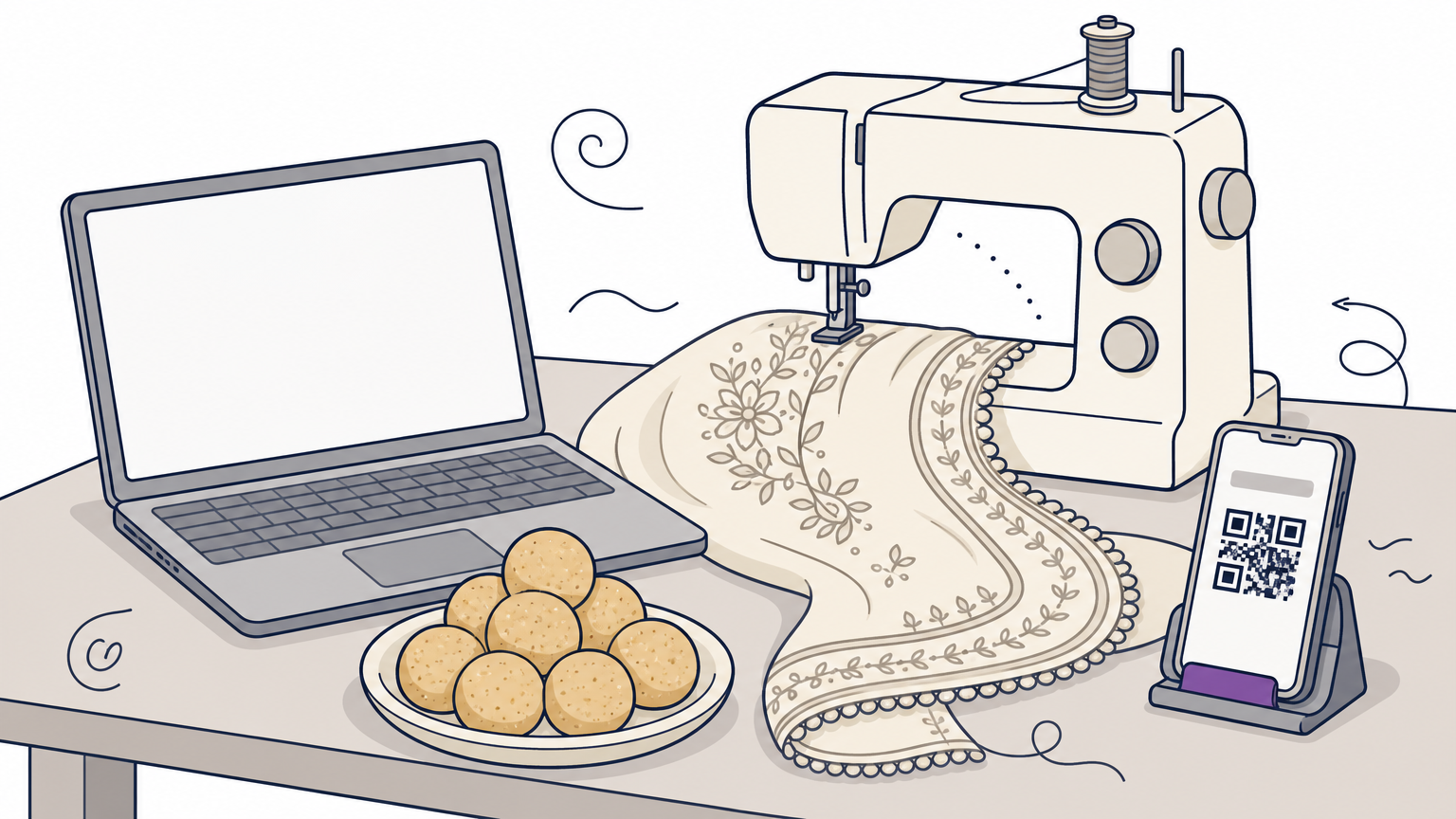
The best small business ideas for home share three traits: you can start with what you already own, you can test demand before spending more, and customers can find and pay you through a simple link or chat. Freelance writing, virtual assisting and online tutoring suit you if your main asset is a skill and a laptop. Home baking, handmade gifts and tailoring suit you if you like making things in small batches. Digital products and workshops suit you if you want income that does not depend on every hour you work.
The hard part is rarely finding an idea. It is choosing one that fits your skills, your free hours and your budget, then setting it up properly in India: the right registrations, a way to get paid, and a way to take orders without losing them in WhatsApp chats. Below you get ten ideas, each with what the work involves, what it costs to start, what you can realistically earn, and how to find your first customers. A cost comparison and the legal basics follow the list.
Pi-Square helps small businesses create a shareable commerce website that works alongside WhatsApp, so a few ideas below include notes on how customers will order and pay. The ideas themselves work with any tool you prefer.
1. Freelance writing and content creation
Freelance writing is the cheapest home business to start, because a laptop, an internet connection and a few samples are enough. You write blog posts, website copy, product descriptions or newsletters for businesses that do not want a full-time writer.
What it involves
Most beginners start with blog posts and product descriptions, then move on to website copy, email newsletters and case studies. The work is remote and deadline-driven, so it fits around a job or a household.
A niche raises your rates. Someone who understands food, finance or software can charge more than a generalist, because clients spend less time explaining their topic.
Startup cost and earnings
Your startup cost is close to zero, plus a domain or portfolio page if you want one. What you earn depends on your rate and your volume.
Take a simple example. At ₹1 per word, a 1,000-word article pays ₹1,000, so 16 articles a month bring in ₹16,000. Rates climb as you build a niche and repeat clients.
A laptop and three good samples are all the stock a writer needs.
Who it suits and first steps
It suits you if you write clearly and meet deadlines without reminders. A specific pitch beats a general offer every time.
- Write three samples on topics you know.
- Publish them on a free blog or your LinkedIn profile.
- Message 10 small businesses a week with one concrete content idea each.
2. Virtual assistant services
A virtual assistant (VA) handles calendars, inboxes, data entry, bookings and customer queries for busy owners, all remotely. It turns organizing skills into income with almost no investment.
What it involves
Typical tasks include email and calendar management, spreadsheet updates, invoice reminders and scheduling social posts. Many small sellers in India run sales on WhatsApp, so a VA who can organize orders and customer chats is valuable.
Offer one narrow service first, such as managing a coach’s bookings, instead of promising everything. A narrow offer is easier to explain and easier to sell to a first client.
Startup cost and earnings
You need a laptop, a reliable connection and free tools such as Google Calendar and Sheets, so your startup cost stays under ₹2,000. Most VAs bill by the hour or by a monthly retainer.
For example, three clients at 10 hours a month each and ₹300 an hour brings in ₹9,000 a month. You earn more once you add bookkeeping, customer support or order management to plain admin work.
Pricing by monthly retainer, not by task, gives a VA income that repeats.
Who it suits and first steps
It suits you if you are organized, prompt and comfortable with routine. Prove your reliability with a small paid trial before you ask for a long contract.
- List the tasks you can handle on one page.
- Offer a one-week trial to two or three owners you already know.
- Ask for a short written recommendation when the trial ends.
3. Online tutoring and coaching
Online tutoring turns a subject you know well into paid sessions over video. School subjects, exam preparation, spoken English, music and coding all sell.

What it involves
You can teach one-to-one or in small batches over Google Meet or Zoom. A batch of four to six students raises your hourly income without adding hours.
Pick a specific audience, such as Class 10 maths or spoken English for working adults. A narrow promise makes parents and learners trust you faster than “I teach everything.”
Startup cost and earnings
You need a laptop, a headset, stable internet and a free whiteboard or screen-sharing tool. That keeps your startup cost under ₹3,000.
At ₹500 per one-hour session, ten sessions a week bring in ₹5,000 a week, or about ₹20,000 over four weeks. Group batches can lift this without extra teaching hours.
Collecting the month’s fee in advance turns tutoring into predictable income.
Who it suits and first steps
It suits patient explainers who enjoy seeing a student improve. Charging monthly in advance also spares you from chasing payments after every class.
- Offer a free 20-minute demo class.
- Share your timings and monthly fee in one message with a payment link.
- Ask each student to refer one friend for the next batch.
4. Social media management
Social media management means running a small business’s Instagram, Facebook or LinkedIn accounts: planning posts, designing creatives, replying to comments and reporting results.
What it involves
Typical work covers content calendars, simple designs and short reels, plus replying to messages. Local shops, salons, clinics and home sellers know they should post but rarely have the time.
Choose one industry, for example restaurants or clinics. Your templates, hashtags and ideas then carry across clients and save you hours each week.
Startup cost and earnings
Free versions of Canva and scheduling tools get you started, so budget under ₹3,000 for paid design or editing apps. A monthly retainer per client is the usual way to charge.
For example, three clients at ₹5,000 each gives ₹15,000 a month. Take on a fourth client only when your posting process is smooth enough to handle it.
Consistency, not creativity alone, is what clients pay a social media manager for.
Who it suits and first steps
It suits creative people who can stay consistent. Build proof first by growing your own page or a friend’s for a month, then show before-and-after results to prospects.
- Pick one industry and study five of its best accounts.
- Create a sample 30-day content calendar.
- Pitch it to three local businesses with a one-month trial price.
5. Digital products and online courses
Digital products, such as templates, study notes, recipe e-books, planners and recorded lessons, let you create once and sell many times.
What it involves
Choose a narrow problem you can solve in a file: a wedding budget planner, an invoice template, or Class 12 revision notes. A simple PDF or spreadsheet is faster to build and test than a full video course.
Nothing needs packing or shipping. Pi-Square lets you collect payments for digital items through one shareable link, and buyers do not need to install an app.
Startup cost and earnings
Your costs are mainly your time, plus a design tool and a domain if you want one. Gateway charges apply on each sale.
For example, a ₹199 template sold 100 times brings in ₹19,900. At a typical payment gateway fee of around 2%, about ₹398 goes to the gateway, though the exact charge depends on your provider.
Presell to your own contacts before you spend weeks building a product.
Who it suits and first steps
It suits you if people keep asking you the same questions about something you know well. Validate demand by selling to your WhatsApp contacts or Instagram followers before building the polished version.
- Post a preview of the product and ask who wants it.
- Take payment for the first 10 buyers at a launch price.
- Improve the file using their feedback, then sell it to everyone else.
6. Reselling and curated product stores
Reselling means buying products at a lower price and selling them at a higher one, either from wholesale markets or from a curated range in one category.
What it involves
Pick a category you understand, such as kids’ clothing, kitchenware, jewelry or festival décor. Buy a small first batch from a wholesale market or supplier you trust.
Quality control matters more than volume. Check every item before dispatch, because returns and complaints eat the margin of a small seller quickly.
Startup cost and earnings
This idea needs stock money, so it is not the cheapest. Budget ₹5,000 to ₹25,000 for a first batch and test 20 to 30 pieces before reordering.
Price each item to cover purchase cost, packaging and your time. If you buy at ₹350, spend ₹30 on packaging and sell at ₹600, you keep ₹220, so 30 sales leave ₹6,600.
Sell a small first batch out completely before you buy more stock.
Who it suits and first steps
It suits people who enjoy sourcing and spotting trends. Keep a simple stock list so you never accept an order for something you have sold out.
- Photograph each item clearly with its price and size.
- Share the catalog on WhatsApp status and Instagram.
- Note which items sell fastest and reorder only those.
7. Handmade gifts, candles and customized products
Handmade and customized products, such as scented candles, resin art, gift hampers, name plates and printed mugs, sell well because buyers pay extra for something personal.
What it involves
Choose one product line and perfect it before you add another. Candles and hampers work well at home because you can make them in small batches with simple tools.
Gifting seasons such as Diwali, Raksha Bandhan and wedding months drive the biggest spikes. Build stock and a customer list two months ahead of each one.
Startup cost and earnings
Expect ₹3,000 to ₹15,000 for materials and packaging for a first range. Make 10 to 20 pieces first and see what sells.
Price in your time, not just materials. Customization, such as names, colors and messages, lets you charge more per piece than a standard product.
Personalization is what lets a home maker charge more than a factory.
Who it suits and first steps
It suits people who enjoy craft and can take feedback calmly. Buyers need to choose options and leave notes, and Pi-Square supports product variants, add-ons, gift packing and custom notes so orders arrive with the details you need.
- Photograph products in natural light.
- Offer two or three variants, not twenty.
- Add a gift-packing option for every product.
8. Home bakery and tiffin service
A home bakery or tiffin service sells food made in your own kitchen: cakes, cookies, snacks, pickles, or daily meals for office-goers and students.
What it involves
Start with three to five items you can make consistently, such as brownies, cupcakes or snacks. Pre-orders reduce waste and let you plan ingredients.
Food has legal requirements, so register with FSSAI before you sell (see the legal basics below). Hygiene matters too, because one bad review travels fast in a local WhatsApp group.
Startup cost and earnings
Budget ₹10,000 to ₹40,000 if you need an oven, molds and packaging. Cooking from your existing kitchen lowers this.
For example, a box of six brownies sells for ₹450 and costs ₹180 in ingredients and packaging, leaving ₹270. Forty boxes a month leave ₹10,800 before gas, delivery and your time. If 10 customers add a ₹100 extra item through WhatsApp Upsells, that is ₹1,000 more, and Pi-Square charges 10% only on that additional sale, which is ₹100. You need to connect WhatsApp Business first.
Pre-orders turn a home kitchen from guesswork into a business you can plan.
Who it suits and first steps
It suits good cooks who can handle weekend rushes. Neighbors and housing-society groups are your easiest first customers, since they trust local food.
- Share a catalog link with prices, order cutoff times and delivery areas.
- Ask happy customers to forward the link to their contacts.
- Look at Pi-Square’s demo bakery store to see how a catalog like this can be laid out.
9. Tailoring, alterations and boutique work
Tailoring from home covers stitching blouses and kurtis, alterations and small made-to-order collections. If you already own a sewing machine, it is one of the lowest-cost hands-on businesses you can start.
What it involves
Demand is steady for blouses, kurtas, alterations and kids’ wear, because buyers want a good fit and fast turnaround. Add boutique-style custom pieces once you have regulars.
Record measurements for every customer, so repeat orders are easy. Set clear delivery dates and take part of the payment in advance to cover fabric and avoid no-shows.
Startup cost and earnings
Your cost is near zero if you own a machine. Budget ₹10,000 to ₹25,000 if you also need a machine, fabric samples and basic notions.
Prices per piece depend on your city and the complexity of the work. Check what two or three local tailors charge and price near them while you build a reputation.
A good fit and a promised delivery date matter more than the lowest price.
Who it suits and first steps
It suits skilled sewers who value finish and fit. Fixed appointment slots for measurements and fittings stop walk-ins from disrupting your day.
- Photograph finished work, with customer permission.
- Set fitting hours, such as two afternoons a week.
- Take a 30% to 50% advance on custom orders.
10. Hobby classes and workshops
Hobby classes and workshops, such as baking, art, dance, yoga or craft sessions, let you sell your skill to groups from your home, a rented hall or online.
What it involves
Run small batches of six to ten people for a fixed fee, and teach one clear outcome, like making a cake or painting a canvas. A one-time weekend workshop tests demand before you commit to a weekly class.
Online classes remove venue costs, while in-person classes allow higher prices. Home classes also depend on your housing society’s rules and your neighbors’ comfort, so check first.
Startup cost and earnings
Budget ₹2,000 to ₹10,000 for materials, basic setup and promotion. Income is fee multiplied by seats, minus materials.
For example, a ₹800 workshop with 8 seats earns ₹6,400. Materials at ₹150 per student come to ₹1,200, which leaves ₹5,200 for one session.
Sell seats with an advance payment, and an empty chair becomes rare.
Who it suits and first steps
It suits confident, people-friendly teachers. Selling seats through a booking link with advance payment holds a spot only when it is paid. Pi-Square handles tickets, registrations and advance payments for classes and pop-ups through one link, so students need no app.
- Fix a date, a seat limit and a price.
- Share the booking link in local groups.
- Send a reminder with directions the day before.
How to choose and set up your home business
Choose the idea where your existing skill, spare hours and budget overlap, then register only for what that idea needs. Comparing startup costs side by side makes that choice quick.
Startup costs and effort side by side
These ranges are ballpark planning figures, not quotes. Your city, supplier and quality level will move them.
| Idea | Ballpark startup cost | What you need | Best if you want |
|---|---|---|---|
| Freelance writing | Under ₹2,000 | Laptop, samples | A fast start |
| Virtual assistant | Under ₹2,000 | Laptop, organization | Monthly retainers |
| Online tutoring | Under ₹3,000 | Headset, whiteboard app | Recurring income |
| Social media management | Under ₹3,000 | Design apps | Creative work for local brands |
| Digital products | ₹0 to ₹5,000 | A file, a payment link | Income beyond your hours |
| Reselling | ₹5,000 to ₹25,000 | First batch of stock | Sourcing and trading |
| Handmade gifts | ₹3,000 to ₹15,000 | Materials, packaging | Gifting-season spikes |
| Home bakery | ₹10,000 to ₹40,000 | Oven, packaging, FSSAI | Repeat local orders |
| Tailoring | Near zero to ₹25,000 | Sewing machine | Skilled hands-on work |
| Workshops | ₹2,000 to ₹10,000 | Materials, space | Group income per session |
If your budget is under ₹5,000, start with ideas 1 to 5. If you like making things, ideas 7 to 9 give you a product people can see and taste.
Legal and tax basics to sort out first
Most of these steps take a day or two, and doing them early avoids trouble later. Rules change, so confirm the current ones on the official sites or with a chartered accountant.
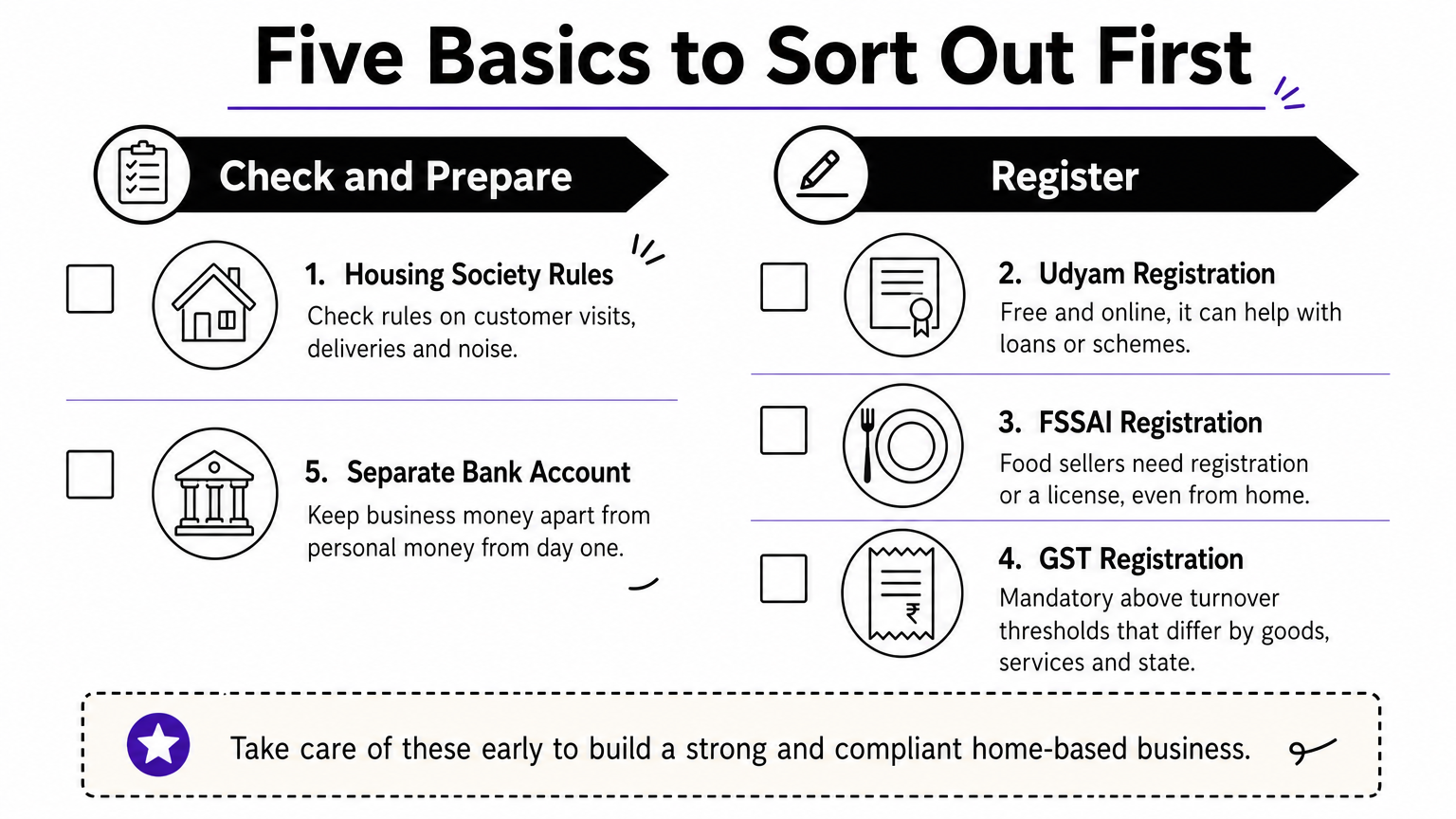
- Housing society or rental terms: check rules on customer visits, deliveries and noise.
- Udyam Registration: it is free and online, and it can help when you apply for business loans or government schemes.
- FSSAI: food sellers need registration or a license, even from a home kitchen, and the category depends on turnover.
- GST: registration becomes mandatory above turnover thresholds that differ for goods and services and by state, and some online sellers need it regardless.
- Bank account: keep business money in a separate account from day one.
Sort out food licenses, GST questions and a separate bank account before your first big order.
Take orders and payments from one link
One shareable link beats scattered chats, because it keeps your catalog, orders and payments in one place. Pi-Square starts free and you upgrade when you need more.
| Free | Pro | |
|---|---|---|
| Price | ₹0 per month | ₹300 per month, or ₹3,000 per year |
| Items | 100 | 1,000 |
| Orders | 100 per month | Unlimited |
| Staff accounts | 2 | 5 |
| Custom domain | No | Yes |
Paying yearly instead of monthly saves ₹600. Payment gateway fees are typically around 2% of order value and go to the gateway provider, while manual payment tracking for cash and UPI is free. GST-compliant invoices can be set up in settings, though your actual obligations depend on your own situation and your tax advisor.
Start small, test, then grow
The strongest small business ideas for home start with a skill or tool you already have, a small first batch or a first client, and a clear way to get paid. Writing, virtual assisting, tutoring and social media cost little. Food, gifts, tailoring and workshops need a bit more but give customers something they can see and taste.
Pick one idea from the table, run a small test with ten people you know, and register for what that idea needs. Add more products or clients only after the first ones are paying you reliably.
When you are ready to take orders, bookings or payments through a single link, you can start free with Pi-Square and set up your catalog in minutes.