Blog
Order Management Software: 4 Best Cloud Options Compared
Compare four cloud-based order management software options for ecommerce and small business, with who each suits, pricing and how to choose.
Published November 27, 2026
The best order management software depends on your order volume, how many channels you sell on, and whether you need warehouse control. Pi-Square suits small sellers who take orders on WhatsApp, social media chats and a simple online link. Zoho Inventory suits growing businesses that want sales orders, stock and shipping in one affordable cloud tool. Unicommerce suits high-volume ecommerce brands selling across marketplaces. NetSuite suits larger companies that need orders tied to full ERP finance.
Most small sellers hit the same wall. Orders arrive in chats, on a website and at the counter, stock sits in a spreadsheet, and payments are chased by hand. Order management software fixes this by capturing every order in one place, tracking inventory, and moving each order from payment to delivery.
This article compares four cloud-based options, from free to enterprise. We build Pi-Square, so we list it first and say plainly where it stops fitting. Each tool is covered by what it does, who it suits and what it costs, followed by a short guide to choosing.
1. Pi-Square
Pi-Square is a cloud-based order management and commerce tool for small sellers, and it is the only tool here built around social media and WhatsApp ordering. It works best when your customers already message you to buy.
What it does
You create a shareable store link from the mobile or web app in minutes. Customers order, book or pay without installing an app. Direct, WhatsApp and manual orders all land in one list, each with a fulfillment status, so nothing stays buried in a chat.
- Real-time inventory with availability toggles
- Payment gateway integration, or manual tracking of cash and UPI payments
- GST compliant invoices, bills and a daily sales dashboard
- Shiprocket integration to create shipments from delivery orders and track them
- Growth tools: WhatsApp upsells, abandoned cart follow-up and discount coupons
Pi-Square turns scattered WhatsApp orders into one tracked list without forcing customers onto a new app.
Who it suits and what it costs
It suits social media sellers, home businesses, bakeries, grocers, boutiques, event organizers and service sellers who are non-technical and price-sensitive. If you run several warehouses or sync stock across marketplaces, pick a heavier tool from this list. Shiprocket needs your own account, and its charges are billed separately.
| Plan | Price | Orders | Items | Staff |
|---|---|---|---|---|
| Free | ₹0 | 100 / month | 25 | 1 |
| Pro | ₹300 / month or ₹3,000 / year | 1,000 / month | 500 | 3 |
| Growth | ₹1,000 / month or ₹10,000 / year | Unlimited | 10,000 | 10 |
Take a bakery with 300 orders a month. The Free plan caps at 100 orders and Pro covers up to 1,000, so Pro at ₹3,000 a year is the fit. That saves ₹600 against ₹3,600 on monthly billing. If all 300 orders average ₹500 and are paid online, the gateway takes about 2%, roughly ₹3,000 on ₹1,50,000, and that goes to the gateway, not Pi-Square. WhatsApp upsells carry a 10% charge only on the additional sales they generate.
2. Zoho Inventory
Zoho Inventory is a lightweight cloud tool that manages sales orders, purchase orders, packages and shipments from one screen. It suits small and mid-sized businesses that want proper stock control without enterprise cost.
What it does
It centralizes sales and purchase orders, creates packages and shipments, and sends delivery updates to customers. It connects with channels such as Amazon and Shopify, so ecommerce orders flow into one place. It also links with the wider Zoho suite, which helps when you already use Zoho for accounting or CRM.
- Sales and purchase order management
- Package, shipment and delivery update workflow
- Marketplace and online store connections
- Stock tracking across items
Zoho Inventory is the sensible step up when a chat-and-link setup no longer covers purchasing and stock.
Who it suits and what it costs
It suits businesses that buy stock from suppliers and sell through several online channels at moderate volume. Plans are paid and tiered by features and users, and they sit well below ERP pricing. Check Zoho’s current India pricing page before you commit. Expect a setup effort, because it is more of a back-office system than a customer-facing store.
3. Unicommerce
Unicommerce is an order and inventory platform aimed at ecommerce brands that sell across many marketplaces and ship from several locations. It suits you when order volume, not store setup, is your problem.

What it does
It pulls orders from multiple marketplaces and your own site into one system. It updates stock across channels to prevent overselling and connects to logistics partners for shipping. This is the core of ecommerce order management software: one inventory number that every channel trusts.
- Multi-channel order capture
- Inventory synchronization across locations
- Courier and logistics integrations
- Returns handling
Unicommerce solves overselling and channel sprawl, which matters only once you sell on several marketplaces at once.
Who it suits and what it costs
It suits established ecommerce brands and D2C sellers with steady daily volume and a fulfillment team. It is more than a beginner needs. Pricing is not a fixed public rate card, so ask the vendor for a quote based on your order volume and channels before comparing it with cheaper tools.
4. NetSuite Order Management
NetSuite is a cloud ERP with order management built in, so every order flows straight into finance, inventory and reporting. It suits mid-size and large companies, not small sellers.
What it does
Orders, inventory, returns and accounting share one database. That gives you centralized reporting, multi-location warehouse visibility and international financial sync. Customer order management here means each order is tied to billing, stock and the ledger without re-entry.
- Order capture and fulfillment tracking
- Multi-location inventory
- Returns and refund processing
- Built-in accounting and reporting
NetSuite is the right answer only when orders and accounting must live in one system.
Who it suits and what it costs
It suits companies with complex operations that already plan an ERP rollout. Pricing is quote-based and sits at the high end, with implementation and training costs on top. For a business with a handful of daily orders, that cost and effort will not pay back.
How to choose order management software
Pick by your current pain, not by feature count. Start with the cheapest tool that handles your real order volume and channels, and move up when a limit actually blocks you.
What to check before you pick
Run through these questions:
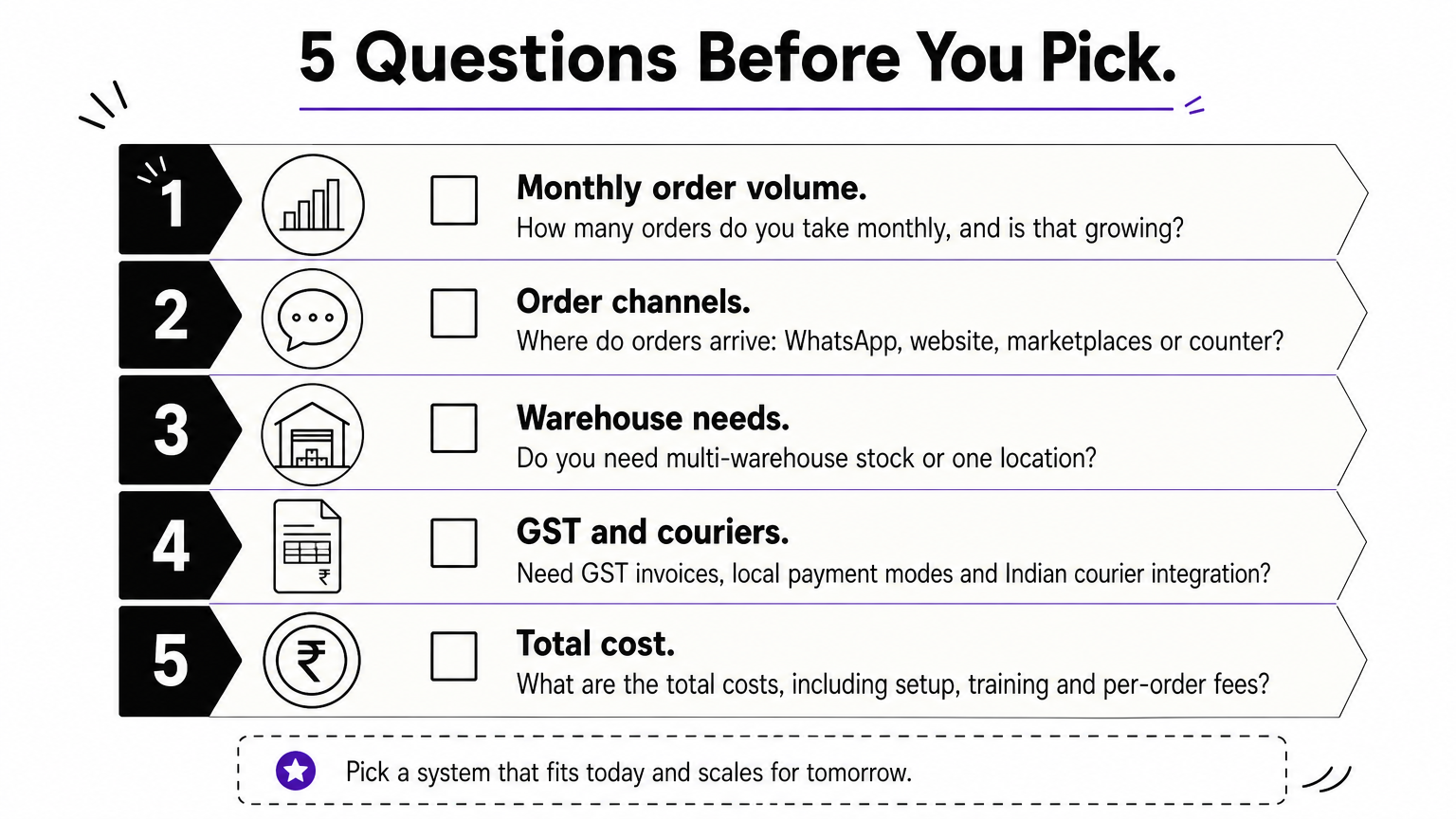
- How many orders do you take per month, and how fast is that growing?
- Where do orders arrive: social media chats, WhatsApp, your website, marketplaces, or a counter?
- Do you need multi-warehouse stock or one location?
- Do you need GST invoices, local payment modes and Indian courier integration?
- What are the total costs, including setup, training and per-order fees?
The right tool is the lightest one that removes your biggest daily bottleneck.
How the four compare
| Tool | Best for | Channel strength | Pricing model |
|---|---|---|---|
| Pi-Square | Small sellers on social media and WhatsApp | Social chats, WhatsApp, link store, manual | Free, then ₹300 / month |
| Zoho Inventory | Small to mid-size businesses | Online stores, marketplaces | Tiered paid plans |
| Unicommerce | High-volume ecommerce brands | Many marketplaces | Quote-based |
| NetSuite | Larger, complex companies | ERP-wide | Quote-based, high |
Pick the tool that matches your order volume
Small sellers rarely need an ERP. They need one list of orders, accurate stock, tracked payments and a clean invoice. Choose Pi-Square if you sell through social media, WhatsApp and a link, Zoho Inventory if purchasing and stock grow complex, Unicommerce for multi-marketplace volume, and NetSuite when finance and orders must merge.
If you are at the first stage, start free with Pi-Square and move to a paid plan only when your order count demands it.