
Blog
Abandoned Cart Recovery Rate: What Is a Good Benchmark?
What is a good abandoned cart recovery rate? See benchmarks from 5% to 30%, the formula, a worked example and how to improve your own rate.
Published November 9, 2026
What is a good abandoned cart recovery rate? For most online stores, recovering 5% to 10% of abandoned carts is a healthy result, and anything above 10% to 15% is strong. Averages near 30% and claims of 40% do circulate, but they usually count recovery more loosely, so they make a poor target for your own store.
Abandoned cart recovery rate is the share of abandoned carts that end in a completed purchase after you follow up with the shopper, usually by email, SMS or WhatsApp. A shopper who adds items and leaves is an abandoned cart. A shopper who comes back through your reminder and pays is a recovered one.
This guide shows you why the number matters, how to calculate it without fooling yourself, which benchmarks deserve your trust, and what to change when your rate is low. At Pi-Square, we help small sellers move orders from WhatsApp chats to a shareable store link, and abandoned cart follow-up is one of the growth tools they use. So the advice below fits a small store as well as a large one.
Why your abandoned cart recovery rate matters
Your recovery rate matters because most shoppers who start a purchase never finish it, and these are the easiest sales you can win back.
Most carts never become orders
The average cart abandonment rate sits between 70% and 77%. The Baymard Institute puts it at 70.22% across 50 studies, while Dynamic Yield reports a global average of 77.38%. The gap comes from how each source counts a cart, not from shoppers behaving differently. In practice, about seven of every ten shoppers who add a product leave without paying.

Those shoppers are not strangers. They picked a product and often reached checkout, so they have already shown intent. Winning one back costs a message, not ad spend to find a new customer. That is why recovery rate deserves a place on your dashboard next to conversion rate.
What a few points of recovery are worth
Take a store where 1,000 shoppers add to cart each month, 700 of them abandon, and the average order is ₹1,200. The table shows what each recovery rate returns.
| Recovery rate | Orders recovered | Revenue at ₹1,200 per order |
|---|---|---|
| 5% | 35 | ₹42,000 |
| 10% | 70 | ₹84,000 |
| 15% | 105 | ₹1,26,000 |
Moving from 10% to 15% adds ₹42,000 a month without any extra advertising. For a small seller, that can cover a month of packaging and delivery costs.
Recovery is the one growth lever where the customer has already chosen the product.
How to calculate abandoned cart recovery rate
Divide the carts you recovered by the carts that were abandoned, then multiply by 100. The formula is simple, but three definitions decide whether your number is honest.
The formula and a worked example
Here is the formula you can copy into a spreadsheet:

Abandoned cart recovery rate = (Recovered carts ÷ Total abandoned carts) × 100
Use the store from the previous section. You had 700 abandoned carts and 70 of them ended in a paid order after a reminder. That gives 70 ÷ 700 × 100 = 10%. Measured against all 1,000 carts created, those same 70 orders are only 7%. That is a different metric, so keep the two apart.
Three decisions that change your number
Before you compare yourself with anyone, fix your definitions on these points:
- What counts as recovered. Count a cart only if the shopper bought after a reminder, or count any purchase by that shopper within a set window. The second method gives a higher number because some people return on their own.
- The time window. Pick a fixed window, such as 7 days from abandonment, and stick to it.
- The denominator. Use all abandoned carts for your store-level rate. Track the conversion rate of reminders you actually sent as a second figure, because it answers a different question.
Be realistic about reminders. Even at a 10% conversion rate, nine of ten people who get a message still do not come back. That is normal, not a failure.
Decide your definition once and keep it fixed, or your trend line tells you nothing.
What counts as a good abandoned cart recovery rate
A good rate is 5% to 10% for typical email-led recovery, and a strong one is 10% to 30%. The published figures disagree because they measure different things.
Abandoned cart recovery statistics side by side
This table sets the commonly quoted numbers next to what each one actually measures.
| Figure | What it measures | How to use it |
|---|---|---|
| 5% to 10% | Common target for recovered abandoned carts | Realistic goal for most stores |
| About 30% (29.81%) | Reported average recovery in one large analysis | Treat anything above it as an improvement, and check the definition first |
| 40% | Claims on some blogs | Do not plan around it |
| 5.8% to 6.5% | Email click rates for browse and cart abandonment in home and garden | Clicks, not recovered orders |
| 70% to 77% | Cart abandonment rate | The problem you are solving, not a recovery benchmark |
Why the average abandoned cart recovery rate varies so much
The average abandoned cart recovery rate swings between 5% and 30% because sources count differently. Some only measure shoppers who opened an email. Some credit every later order from a shopper who left a cart. Others cover only carts where the store has the shopper’s contact details. A tight definition produces a low number and a loose one produces a high number.
A store that reports 6% on a strict definition is in the normal band, not failing. Compare your rate only with a benchmark that uses your definition. If the source does not state its method, discount the figure heavily.
A practical scale for your store
This is my rule of thumb when you use the strict formula above:
| Your rate | Reading |
|---|---|
| Under 5% | Weak. Follow-up is missing, late or broken. |
| 5% to 10% | Normal and healthy. |
| 10% to 30% | Strong. Protect what is working. |
| Above 30% | Exceptional, or measured loosely. Audit the definition. |
A good recovery rate is 5% to 10% on a strict count, and above that only if you can explain how you measured it.
How to improve your abandoned cart recovery rate
Send a timely, specific reminder, remove the reasons shoppers leave, and follow up on the channel your customers already use. These changes move the number more than any clever subject line.
Fix the timing and the message
Send the first reminder within an hour, while the shopper still remembers the product. Then use a simple sequence:
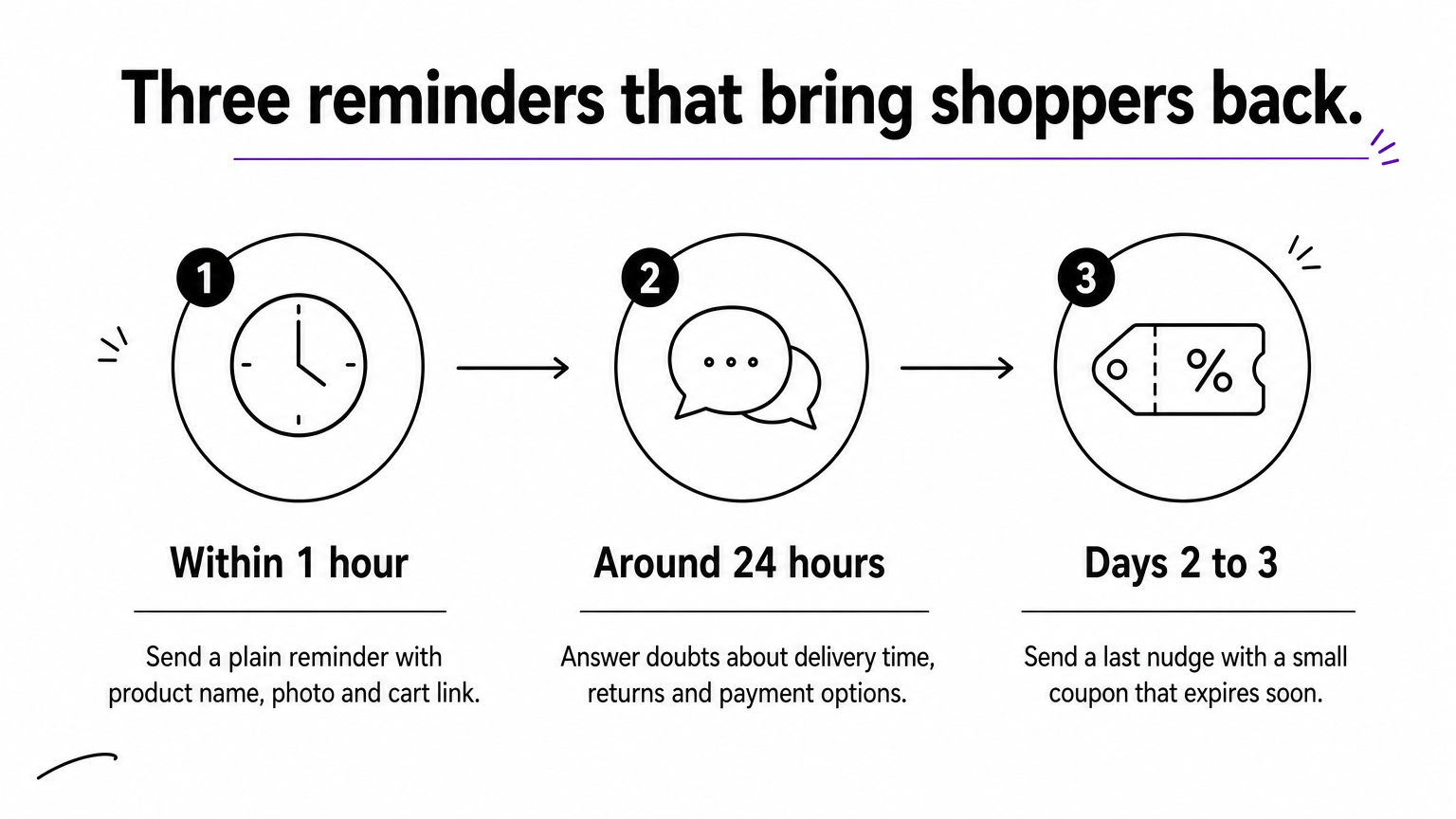
- Within 1 hour: a plain reminder with the product name, a photo and a direct link back to the cart.
- After about 24 hours: answer likely doubts such as delivery time, returns and payment options.
- After 2 to 3 days: a last nudge, ideally with a small coupon that expires soon.
Keep each message short and send only one call to action. A reminder that makes the shopper search for the cart again loses the sale.
Remove the reasons shoppers leave
Unexpected extra costs such as shipping and fees are among the most common reasons for abandonment in Baymard’s research. Show the full price early, offer guest checkout, and make sure the checkout works smoothly on a phone. For Indian shoppers, make UPI easy to use, since a failed or confusing payment step looks like abandonment in your data.
Follow up where your customers already are
Many small sellers talk to customers on WhatsApp, so a reminder there often feels more natural than an email. Pi-Square identifies customers who abandoned carts so you can follow up, and its discount coupons let you offer a percentage or fixed discount with an expiry date, an order limit and first-order controls. Customers need no app, only your link, so coming back takes one tap.
Fast, specific follow-up on the channel your customer already uses beats a bigger discount sent late.
Where to aim, and what to do next
Calculate your rate with one fixed definition, then compare it with the 5% to 10% band. If you sit below it, fix timing and checkout friction first. If you are inside it, test a coupon on the third reminder. Be wary of any benchmark above 30% that does not explain how it was counted.
Recovery is a habit, not a campaign. Measure it every month, change one thing at a time and keep the winners. If you sell through WhatsApp or a simple link and want follow-up built in, you can create your free Pi-Square store link and start recovering carts you are probably losing today.